The technology inside the Pin Mill
Impact · screenless — how it works, the equations we size it with, and what can be adjusted.
Pin Mill
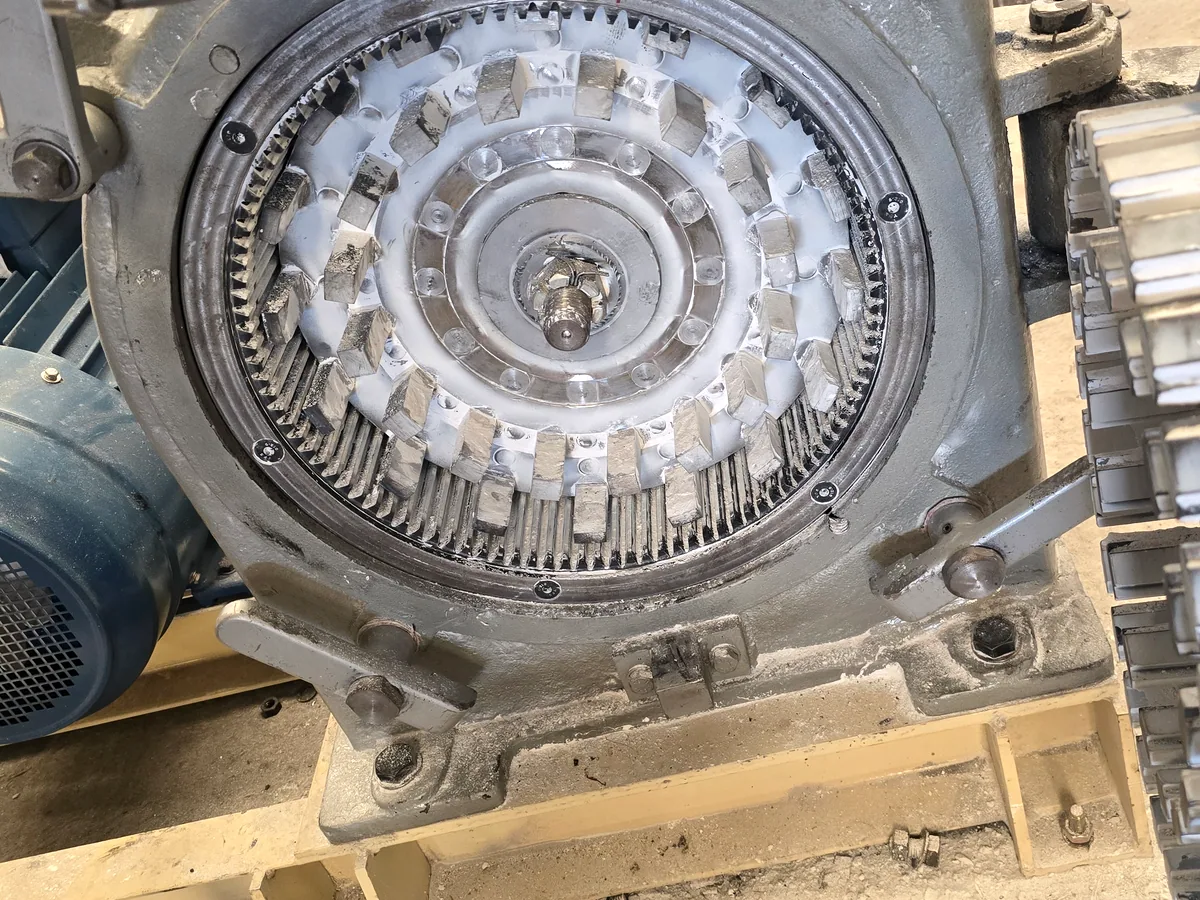
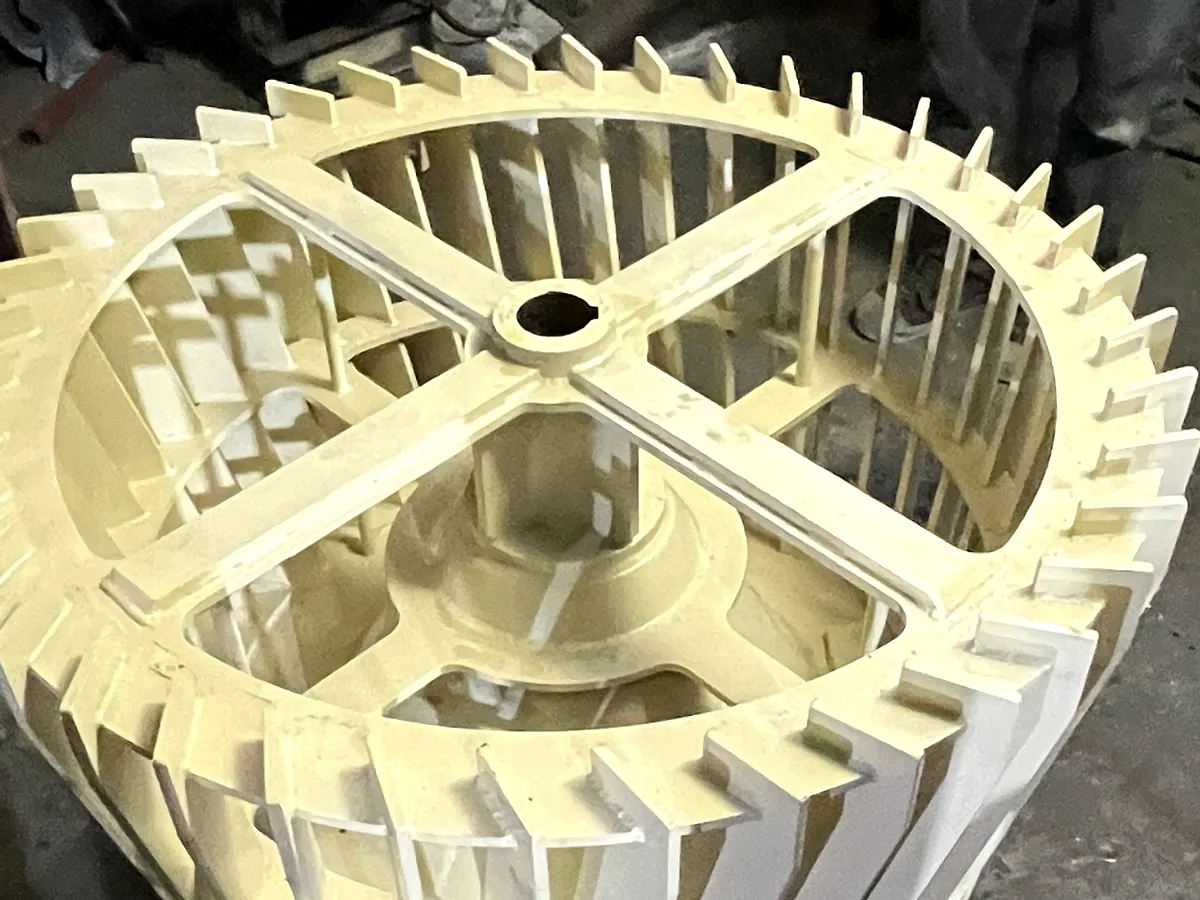
Two discs studded with concentric rings of pins face each other. One spins, one stays still, and the feed is thrown outward through ring after ring of impacts.
- 01Feed enters through the centre of the stationary disc at a controlled rate.
- 02Centrifugal force throws it outward through the first pin ring.
- 03Each successive ring has a higher circumferential speed, so every collision is harder than the last.
- 04Product leaves at the rim — with no screen there is nothing to blind or wear through.
Fineness follows tip speed, not screen size
A pin mill has no aperture to set the product size. The break happens when the kinetic energy delivered at impact exceeds the fracture energy of the particle, so the size you get is governed by tip speed and the number of impacts on the way out.
Because impact energy rises with the square of speed, a 20 % increase in rotor rpm gives roughly 44 % more energy per hit — which is why the same machine can move across a wide fineness band without any mechanical change.
- Tip speedv = π · D · n / 60
- v
- tip speed (m/s) — up to 120 m/s
- D
- outer pin-ring diameter (m)
- n
- rotor speed (rpm)
Set v first from the target fineness, then choose D and n to reach it.
- Impact energy per collisionE = ½ · m · v²
- E
- energy delivered to one particle (J)
- m
- particle mass (kg)
- v
- relative impact velocity (m/s)
Fracture occurs once E exceeds the material's specific fracture energy.
Tuned to your material
- AdjustVariable-speed rotorA VFD moves tip speed across the working range, so one machine covers coarse and fine grades without stripping down.
- AdjustPin-ring configurationRing count and pin pitch are chosen per material — more rings for a narrower spread, fewer for higher throughput.
- UpgradeTungsten-carbide pinsFor abrasive feeds, carbide-tipped pins extend service life by several times over hardened steel.
- UpgradeJacketed chamberChilled water or LN₂ keeps heat-sensitive product below its softening point through the whole run.
- UpgradeSanitary 316L buildCrevice-free welds, sanitary seals and tool-free rotor access for food and pharma duty.
- UpgradeInert-gas operationNitrogen blanketing with an O₂ trip point for dust-explosion-prone powders.