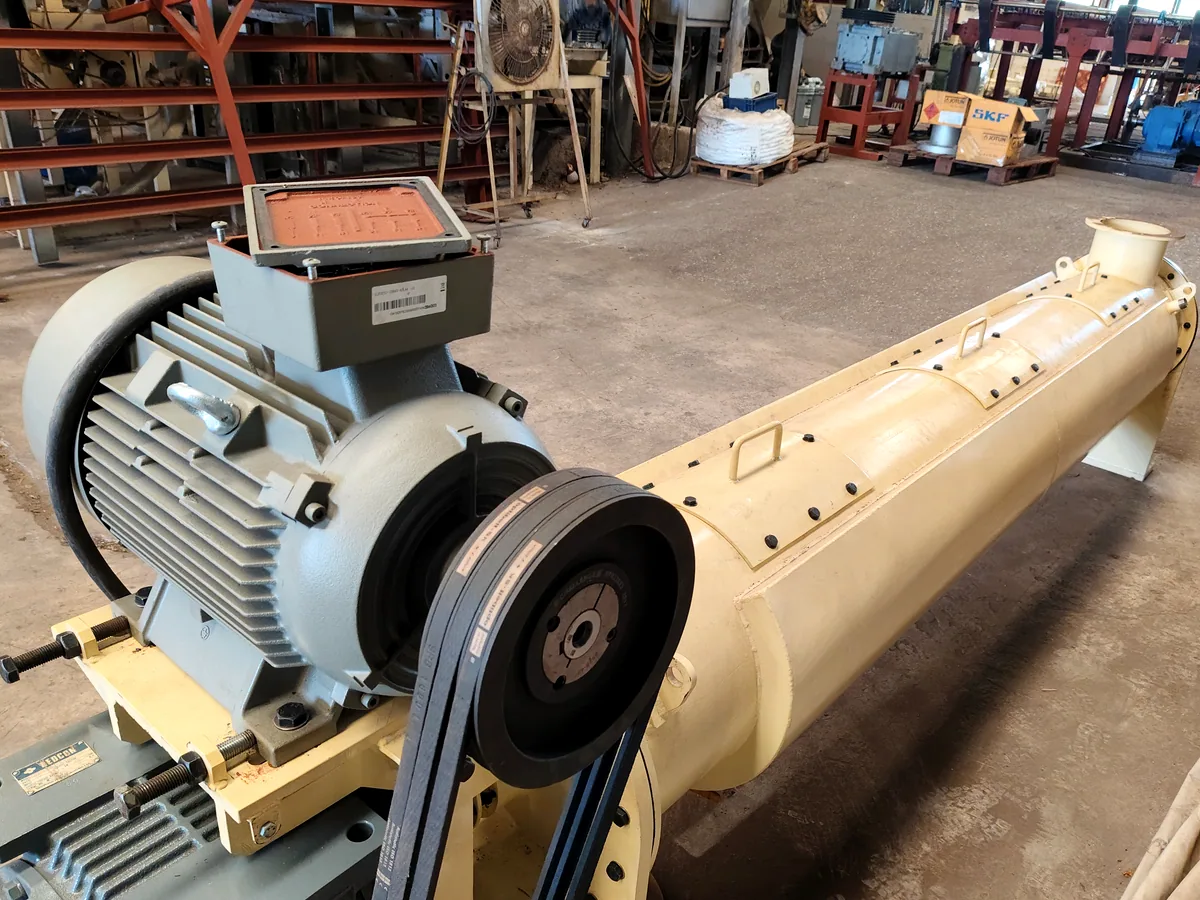
Air Classifier
Technology
Below 45 microns, physical screen sieving becomes highly inefficient or mechanically impossible — mesh blinds, throughput collapses, and the screen itself becomes the weak point Air classification bypasses these mechanical limits entirely It is a screenless, dynamic aerodynamic process that suspends particles in a controlled gas stream and fractionates dry bulk powders into fine and coarse streams with exceptional precision, high mass flow and minimal maintenance
- Mechanism
- Aerodynamicseparation
- Cut point
- 2 – 150µm
- Primary control
- RPM+ airflow
- Capacity
- Up to 35TPH
A tug-of-war between spin and suction
Inside the classifier, every suspended particle is caught between two opposing force fields — the outward centrifugal force of the rotating turbine, and the inward aerodynamic drag of the suction air flow Coarse particles, heavy for their drag, are flung outward and rejected; fines are carried with the air in through the rotor The one size at which the two forces balance exactly is the cut point
Where the sieve stops
In fine and ultra-fine powder processing, physical screen sieving fails below 45 µm for three compounding mechanical reasons — and a dynamic classifier sidesteps all of them
Screen blinding
Fine mesh clogs severely in continuous duty Apertures blind, effective open area collapses, and the separation drifts off-spec
Fragile mesh
The finer the aperture, the thinner the wire Below 45 µm a screen is structurally weak — short service life and constant risk of breakage and contamination
Restricted throughput
Open area shrinks with aperture size, so capacity falls exactly where industry needs volume Air classification instead delivers high mass flow with minimal maintenance
Two forces decide every particle's fate
In the separation zone, each suspended particle feels a physical tug-of-war — the rotating turbine throws it outward while the suction air flow drags it inward Which force wins depends on particle size, and that is the entire working principle
For a sphere, mass is (π⁄6) d³ ρₚ — it scales with the cube of diameter Double the particle size and the outward throw is eight times stronger, so coarse grains are rejected back outward
- m
- Particle mass — (π⁄6) d³ ρₚ for a sphere
- ω
- Angular velocity of the rotor — rad/s
- r
- Outer radius of the classifier wheel — m
In the laminar regime (Re < 1), drag scales only linearly with diameter — so for fine particles the inward pull of the air wins, and they ride the flow through the rotor into the fines stream
- µ
- Dynamic viscosity of the gas — Pa·s
- d
- Particle diameter — m
- vᵣ
- Radial air velocity at the rotor perimeter — V₀ / 2π r H
The cut size, derived
Set the two forces equal and a single particle size sits in perfect equilibrium — the theoretical cut size d₅₀ Everything an operator controls appears in one expression
Substituting vᵣ = V₀ / 2π r H gives the practical form d₅₀ ∝ √V₀ / vₜ — finer cuts come from higher rotor tip speed or lower airflow; coarser cuts from the reverse
- µ
- Gas viscosity
- vᵣ
- Radial air velocity — V₀ / 2π r H
- ρₚ
- Particle density
- ω
- Angular velocity — π n / 30 at n RPM
- r
- Rotor radius
Two levers move the cut point
The cut-size equation reduces day-to-day operation to two independent controls — rotor speed and airflow — with the material itself setting the baseline
Rotor tip speed (vₜ)
The dominant lever d₅₀ scales inversely with tip speed — ramp the motor RPM up and the cut moves finer; back it off for a coarser top size
Volumetric airflow (V₀)
d₅₀ scales with the square root of airflow More air drags larger particles through the rotor for a coarser cut; less air sharpens the cut finer
Particle density (ρₚ)
Denser materials feel a stronger centrifugal throw, so the same settings cut them finer Every material needs its own operating point
Gas viscosity (µ)
Higher viscosity means more drag per particle Gas choice and temperature shift the cut — relevant in heated or inert-gas (N₂ / Ar) loops
Why fine cuts demand multiple rotors
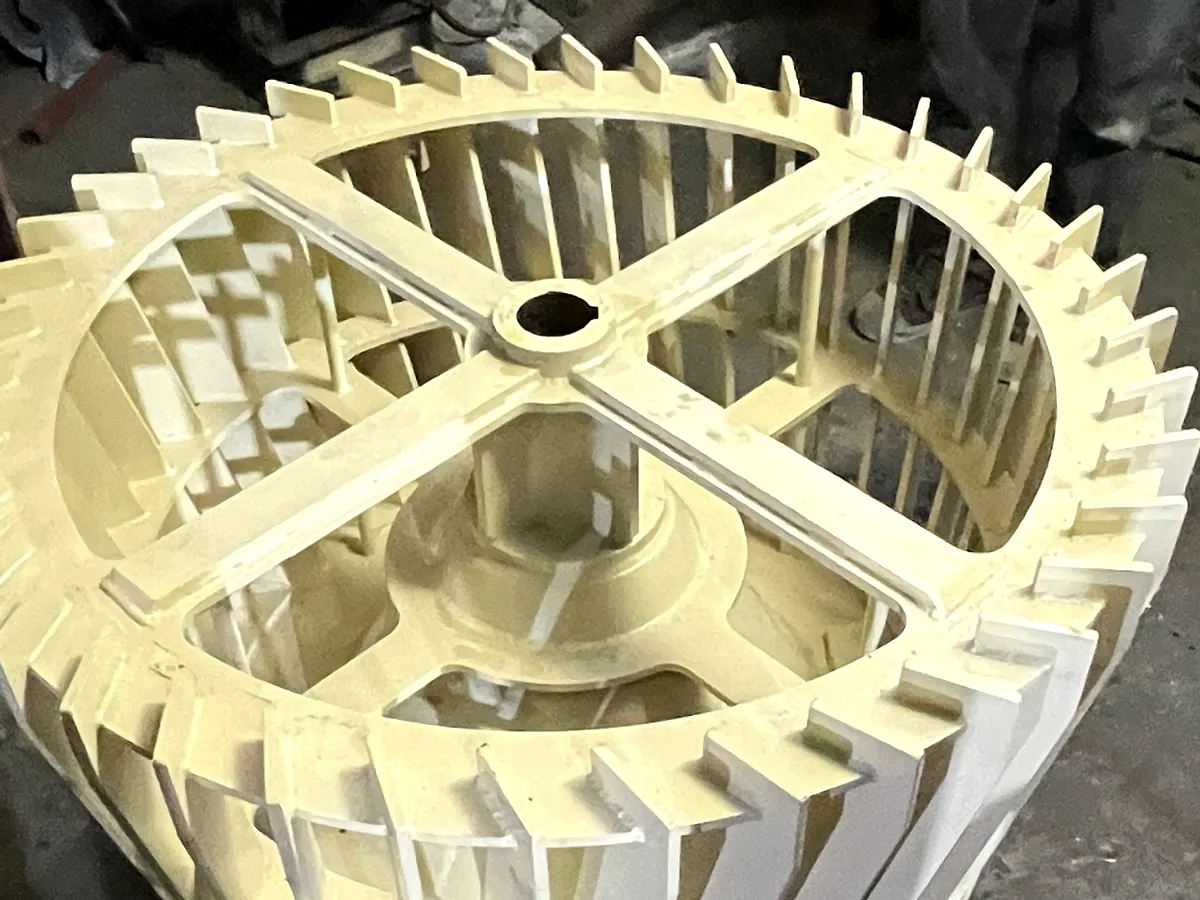
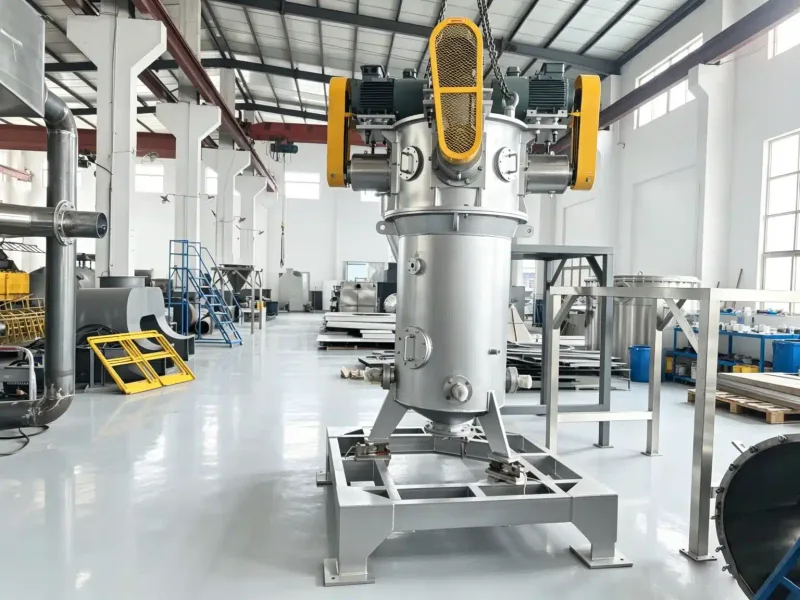
A fine cut of 1 – 5 µm needs rotor tip speeds of 60 – 80 m/s Scale a single rotor large enough for production airflow and the centrifugal stress can deform or shatter a standard steel turbine — while axial flow variations along its height let coarse grains bypass the field The multi-rotor architecture (as in the THOR-AC-HM Series) resolves both, at feed capacities up to 35 TPH
Minimized diameter
Several small rotors run in parallel Each can spin at the extreme RPM needed for high tip speed — safely inside its mechanical stress limit
Expanded surface area
Total classification area multiplies, so high volumetric airflow passes without raising the radial velocity — the fine cut survives at massive feed rates
Synchronized VFD control
A synchronized variable-frequency drive holds every rotor at an identical tip speed — no partition-curve tilting, and a sharp, secure top-cut
Close the loop, stop over-grinding
In closed-circuit milling — hammer, ball or jet — the classifier continuously vacuums material from the mill housing and immediately removes correctly sized fines, returning only oversize The grinding chamber stays clear, over-grinding stops, and specific energy consumption drops 30 – 40 % versus an open grinding loop For combustible, pyrophoric or reactive powders — lithium-ion battery carbon and graphite anodes among them — the same loop runs on recirculated nitrogen or argon, monitored by continuous oxygen sensors