The technology inside the Jet Mill
Fluid energy · media-free — how it works, the equations we size it with, and what can be adjusted.
Jet Mill
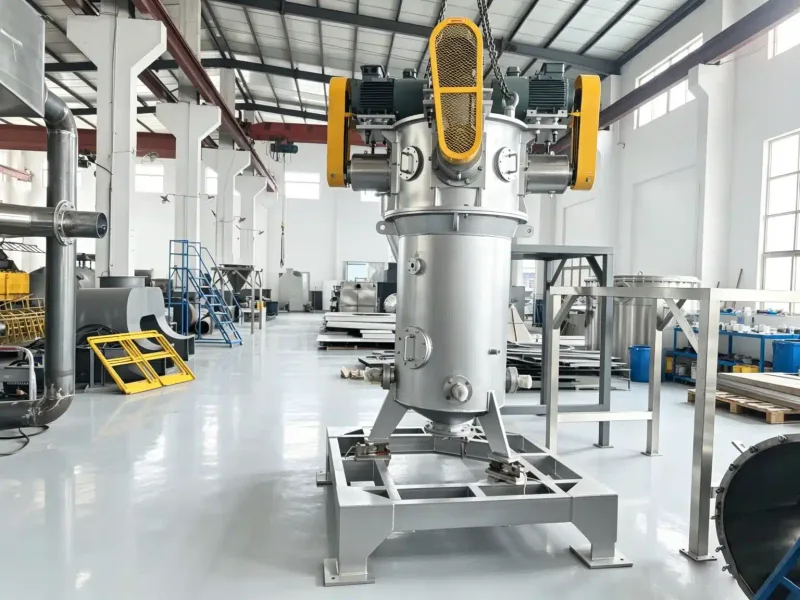
Compressed air expands through tangential nozzles into a flat chamber, forming a high-speed vortex. Particles are accelerated into each other — the material grinds itself.
- 01Feed is injected into the vortex by a venturi at a metered rate.
- 02Tangential nozzles accelerate the gas to sonic velocity, dragging particles with it.
- 03Particle-on-particle collisions fracture the material with no contact surface involved.
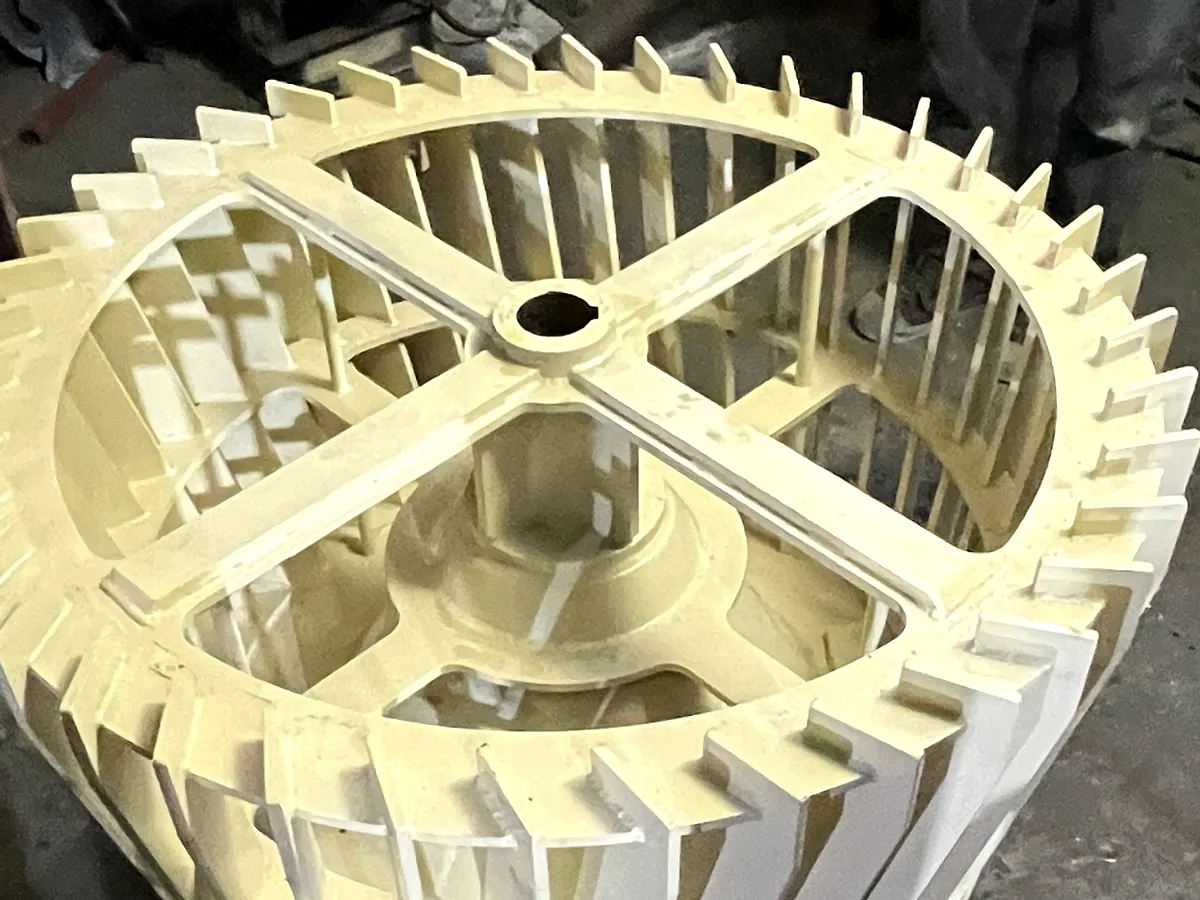
- 04Centrifugal classification holds coarse particles in the vortex; fines exit at the centre.
Grinding without a grinding surface
In a jet mill the energy carrier is the gas, not a rotor. Because nothing solid touches the product except the chamber wall, there is no wear metal to contaminate the batch — the reason this is the only route accepted for many APIs and battery materials.
The classification that decides the cut is a force balance: drag pulling a particle inward against centrifugal force pushing it outward. Solve the two and you get the size at which a particle is equally likely to leave or stay.
- Cut size from the force balanced₅₀ = √( 18 · η · vᵣ · R / (ρₚ · u²) )
- d₅₀
- cut size — half of this size reports to fines (m)
- η
- gas viscosity (Pa·s)
- vᵣ
- radial gas velocity (m/s)
- ρₚ
- particle density (kg/m³)
- u
- tangential velocity at radius R (m/s)
Denser material cuts finer at the same setting — density enters the result directly.
- Grinding intensityR = ṁ_air / ṁ_solid
- R
- air-to-solid mass ratio
- ṁ_air
- compressed air mass flow (kg/h)
- ṁ_solid
- feed rate (kg/h)
A higher ratio means finer product; feed rate is the fastest lever an operator has.
Tuned to your material
- AdjustGrinding pressure6 to 10 bar at the nozzles moves the D50 across its full range while the machine keeps running.
- AdjustClassifier wheel speedAn independent drive sets the cut point without changing grinding energy.
- AdjustFeed rate controlLoss-in-weight feeding holds the air-to-solid ratio steady so the size distribution does not drift.
- UpgradeZrO₂ ceramic liningZirconia liners for materials where even trace iron pickup is unacceptable.
- UpgradeClosed-loop nitrogenRecirculating inert gas for oxygen-sensitive or explosive powders, with continuous O₂ monitoring.
- UpgradeContainment isolatorOEB 4–5 containment for potent compounds, with wash-in-place before the chamber is opened.