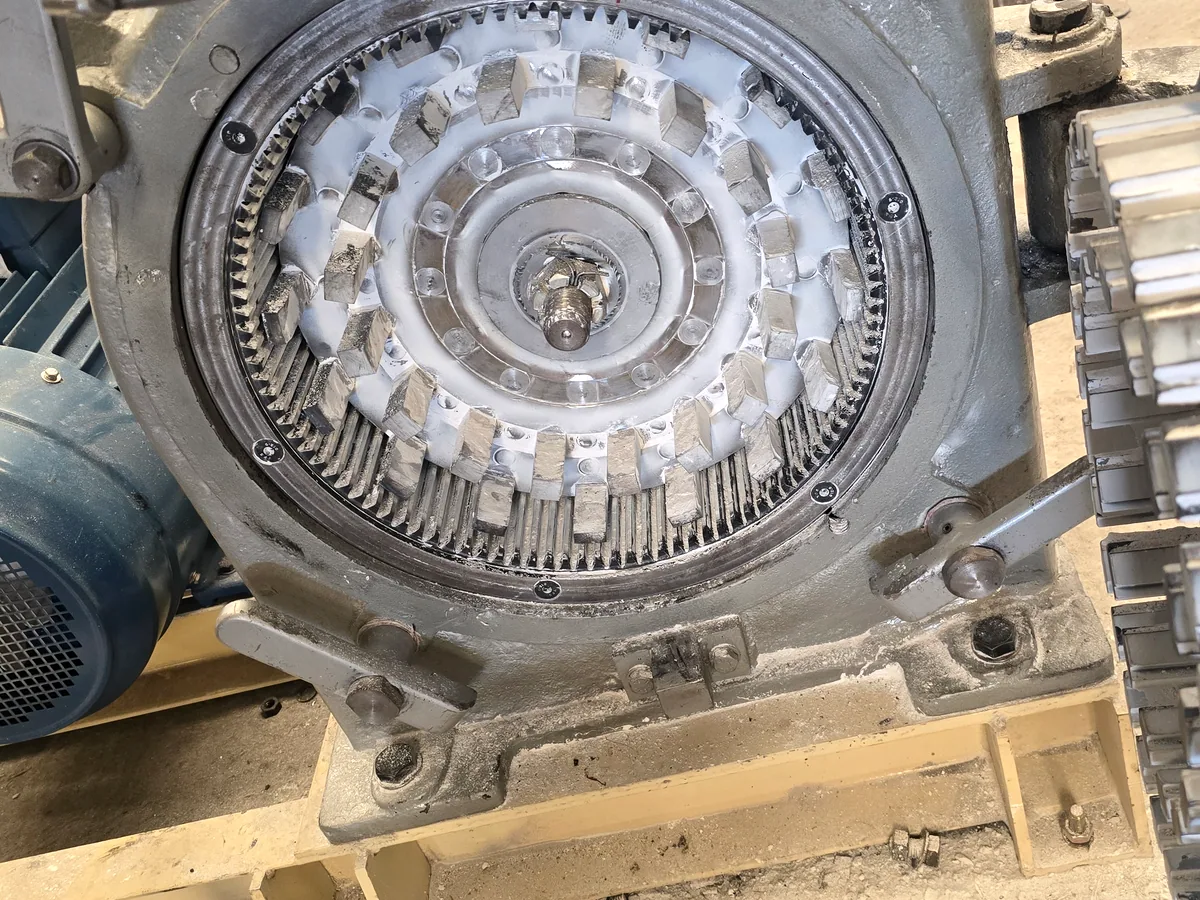
Impact milling without a screen
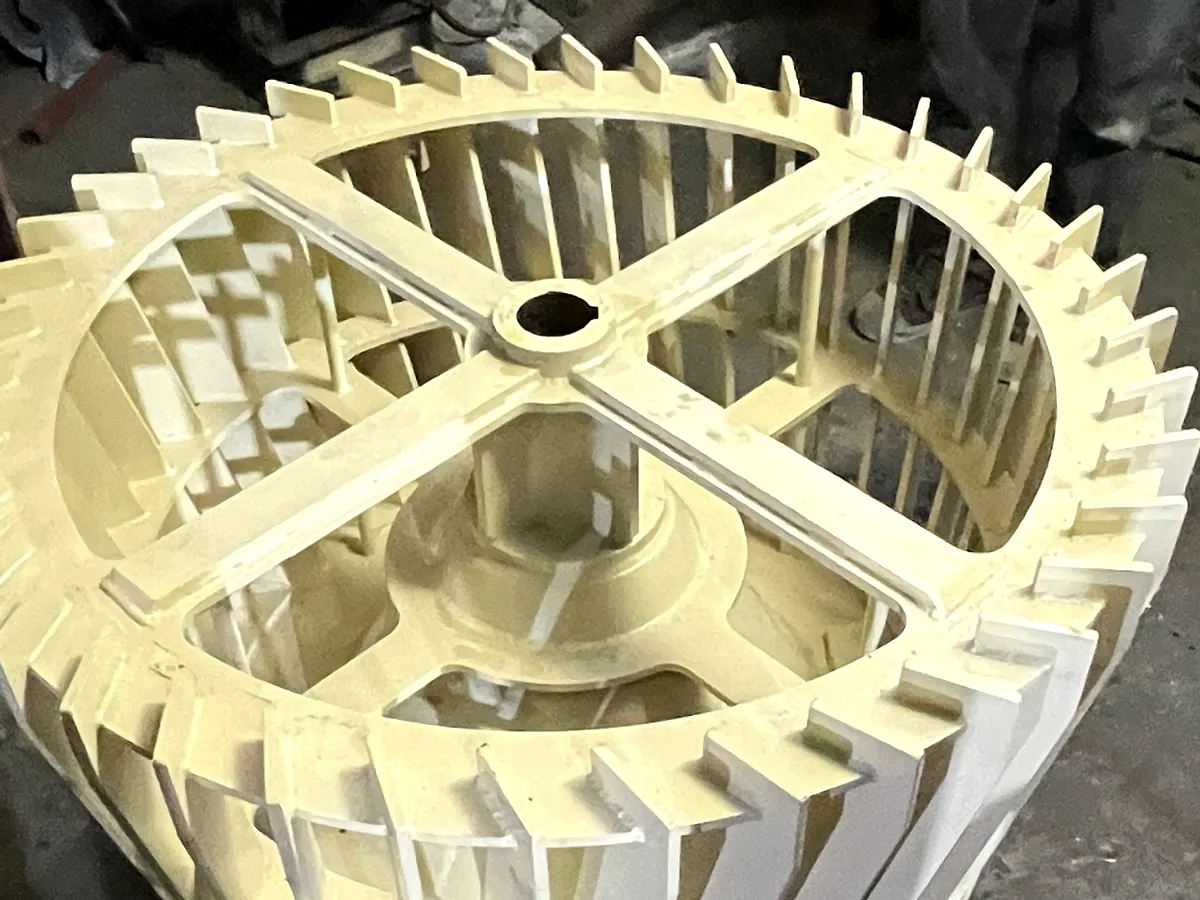
Two discs face each other, each carrying concentric rings of hardened pins — one spins up to 110 m/s while the other stays fixed. Feed enters at the centre and is flung outward through ring after ring of impacts.
- Mechanism
- Impact · screenless
- Fineness
- 20 – 200 µm
- Capacity
- 10 kg/h – 10 t/h
Working principle
No screen means nothing to blind or tear: the residence time is milliseconds, heat stays low, and the size spread comes out naturally narrow — which is why food and pharma plants pick it first.
What the material passes through
- 1Feed hopper & dosing screwMeters the feed into the disc centre at a steady rate
- 2Rotating pin discUp to 110 m/s tip speed — the impact energy source
- 3Static pin discIts pin rings interleave the rotor's, doubling impacts per pass
- 4Grinding gapParticles zig-zag outward through 3–5 pin rings
- 5Outlet to cyclone / bag filterAirflow carries the powder out to collection
What is a Pin Mill?
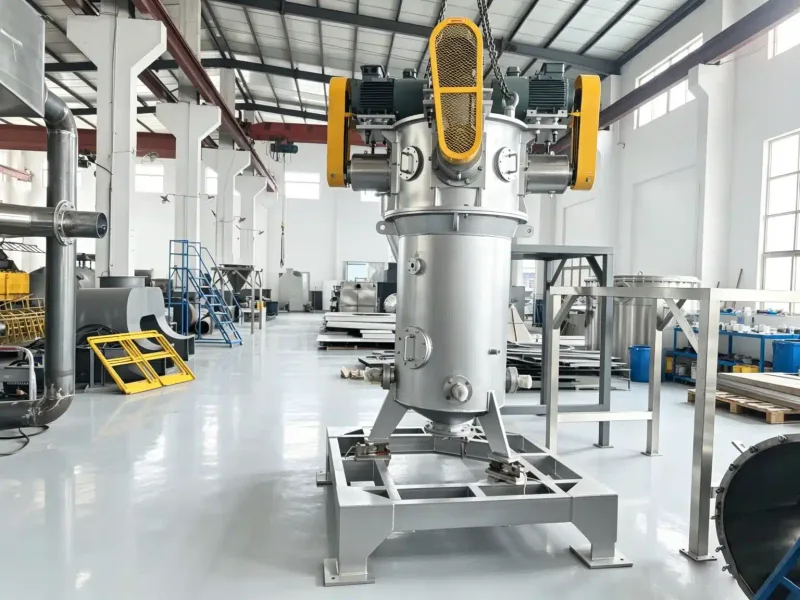
A pin mill is an industrial dynamic-impact grinding machine engineered to achieve fine to micro-fine particle-size distributions. THOR by CI offers the series in two core configurations: Screened and Screenless.
The Screened Pin Mill surrounds the milling chamber with a high-precision sieve to enforce a strict mechanical cut-off size. The Screenless Pin Mill relies entirely on centrifugal aerodynamics to sweep fine particles out — bypassing physical meshes and completely circumventing screen-plugging (blinding). This flexibility lets one platform process dry, crystalline, brittle, oily and soft materials into fine powders.
Where Pin Mill sits on the particle-size scale
Three mills in one base machine
The peripheral insert is fully interchangeable — change the cut, change the mode, on the exact same chassis.
Screened — Strict mechanical top-cut
An interchangeable sieve screen at the discharge boundary lets only sub-aperture particles pass — tight control over maximum particle size.
Screenless — Air-swept, no blinding
A smooth-bore spacer ring replaces the screen; the rotating disc's air current sweeps fines to a peripheral chute — eliminating any chance of screen blockage.
Liner-equipped — Impact + friction attrition
A segmented, high-durability ribbed grinding liner (breaker ring) slides in — projecting particles against heavy ridges to combine pin impact with aggressive shear.
Advantages & limitations
What the THOR-PM does exceptionally — and where pin-mill physics sets a ceiling.
Advantages
Standardized 3-in-1 platform
Swap screened, screenless and liner modes on one base machine — slashing CAPEX and spare-parts inventory.
Hygienic clean-in-place design
316L stainless, mirror-polished surfaces and seamless welds — a true micro-pulveriser for food and pharma.
Narrow particle-size distribution
Precise intermeshing pin geometry yields a tight PSD — consistent product, minimal over-grinding.
Operational versatility
Runs standalone for intermediate fine grinding, or couples downstream with dedicated classification.
Modular classifier compatibility
For separation down to 10 µm, couple the discharge to a THOR-AC Air Classifier that returns coarse to the mill centre.
Limitations to plan for
Vulnerability to abrasive wear
Quartz, silica or sand (Mohs >3.5) wears the pins fast — risking contamination and frequent pin replacement.
Screen blinding in screened mode
Cohesive, fatty or hygroscopic feeds can bind the sieve — switch to screenless or an air-classification loop.
Friction heat accumulation
High rotor speeds heat the chamber and can melt fats, chocolate or sugar unless water-cooling or LN₂ dosing is fitted.
High idle power draw
Spinning the disc to 18,000 rpm demands substantial power to overcome drag and inertia, even when empty.
Milling, mixing & bulk handling
The THOR-PM Series drops into automated, continuous process lines.
Controlled gravity feeders
Variable-speed rotary valves or electromagnetic vibratory feeders meter the central inlet to prevent over-feeding.
Dust-free pneumatic receivers
Fine powder discharges straight into a vacuum conveyor or positive-pressure transport line — no ambient contamination.
Dynamic air-classifier loops
Couple to a THOR-AC Air Classifier in a closed pneumatic circuit to tune the product top-cut D97 in real time.
How it sits against the other four
| Spec | Pin Mill | Hammer Mill | Jet Mill | Ball Mill | Air Classifier |
|---|---|---|---|---|---|
| Mechanism | Impact · screenless | Impact + screen | Fluid energy | Attrition + impact | Centrifugal cut |
| Fineness | 20 – 200 µm | 200 µm – 5 mm | D50 1 – 10 µm | 20 – 200 µm | D97 3 – 200 µm |
| Capacity | 10 kg/h – 10 t/h | 2 – 25 t/h | 20 – 800 kg/h | 0.65 – 80 TPH | 0.5 – 20 t/h |
| Strength | Narrow size spread | Rugged throughput | Finest, contamination-free | Wet or dry, hard feeds | Sharp cut point |
| Best for | Food, pharma, soft chemicals | Grain, biomass, ore | API, pigment, ceramic | Clinker, minerals, refractory | Downstream of any mill |
Specifications
Six frame sizes from bench-scale to heavy industrial. Final sizing is confirmed after pilot trials with your actual feed material.
| Model | Rotor diameter | Motor power | Rotor speed | Capacity |
|---|---|---|---|---|
| TH-PM-160 | Ø160 mm | 3.7 – 7.5 kW | 6000 – 18000 rpm | 10 – 50 kg/h |
| TH-PM-250 | Ø250 mm | 11 – 18.5 kW | 4000 – 12000 rpm | 100 – 800 kg/h |
| TH-PM-400 | Ø400 mm | 30 – 45 kW | 2500 – 7500 rpm | 800 – 1800 kg/h |
| TH-PM-630 | Ø630 mm | 55 – 90 kW | 1600 – 4800 rpm | 2000 – 4000 kg/h |
| TH-PM-800 | Ø800 mm | 100 – 160 kW | 1200 – 3600 rpm | 4000 – 7000 kg/h |
| TH-PM-1000 | Ø1000 mm | 160 – 250 kW | 1000 – 2800 rpm | 7000 – 10000 kg/h |
Specifications are typical and subject to change. Final sizing confirmed after pilot trials with your feed material.
Turn it around yourself
The production machine, modelled from the SolidWorks assembly — drag, orbit and zoom into it right on this page.
What we keep on the shelf for you
Every wear part is made in Nonthaburi and ships immediately, backed by our own service crew.
- Pin discs (pair)Hardened tool steel or 316L
- Individual pinsReplaceable ring by ring
- Chamber linerWear sleeve for abrasive feeds
- Shaft seals & gasketsFood-grade sets available